
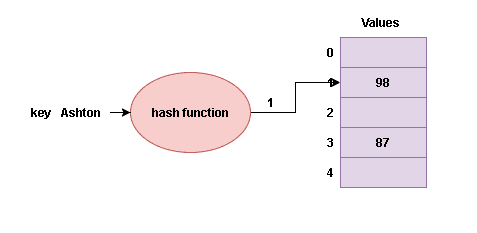
In this article, we will learn to implement a hash table using a singly linked list. A hash table is a data structure that stores items in an array of buckets/ slots. It has a hash function that takes a key as an input and generates an index into an array of buckets. We put the value of the key at that index. Let’s say we want to store scores of students in a hash table. We will pass the name as a key to the hash function, and it will output the index. Then, we will store the score at that index. Later, if we want some student’s score, we will call the hash function with that key (name), and it will give us its location in the array.
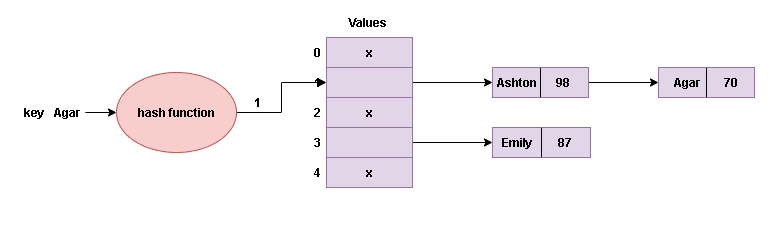
But what if the hash function generates the same index for two different names (keys). Then, there will be a collision. To handle that, we will use the separate chaining method. Each array item points to a singly linked list, which contains (key, value) pairs. Moreover, nodes in the same linked list have the same hash code (index). Consider the following figure to understand this concept.
Implementation of Hash Tables Chaining with Singly Linked Lists
Let’s now go ahead and implement hash tables chaining with singly-linked lists. It will have the following functionalities.
- Insert: It takes a key and a value. If the key already exists, then it updates the value. Otherwise, it adds a new item.
- Delete: It takes a key and removes an item with that key. It also returns the value of the deleted item. If no element with the given key exists, it throws an error.
- Search: The input is a key, and the output is the value of that key. If not found, then an error gets thrown.
- Traverse: It displays all (key, value) pairs.
The code is given below.
class Node:
  def __init__(self, key=None, value=None):
    self.key = key
    self.value = value
    self.next = None

#implementation of linked list for the hash table
class LinkedList:
  def __init__(self):
    self.head = None

  #add or update a node, return 0 if node added and 1 if node updated
  def insert(self, key, value):
    node = Node(key, value) #create a node
    if self.head == None: #if list is empty insert a node at the start
      self.head = node
      return 0
    else:
      temp = self.head
      #iterate through the list till last node is found or key already exists
      while temp.next:
        if temp.key == key: #update value if key already exists
          temp.value = value
          return 1
        else:
          temp = temp.next

      if temp.key == key: #update value if key already exists
          temp.value = value
          return 1
      temp.next = node #adding a new node
      return 0

  #find a node with the key in the list or throw an error
  def search(self, key):
    temp = self.head
    #iterate through the list
    while temp:
      if temp.key == key:
        return temp.value
      else:
        temp = temp.next

    raise KeyError(f'Item with the key {key} does not exist')

  #remove the node with the given key from the list or throw an error
  def delete(self, key):
    if self.head: #if the list is not empty
      if self.head.key == key: #if the node to be deleted is the first node
        value = self.head.value
        self.head = self.head.next
        return value
      else:
        temp = self.head
        #iterate through the list
        while temp.next:
          if temp.next.key == key:
            value = temp.next.value
            temp.next = temp.next.next
            return value
          else:
            temp = temp.next

    raise KeyError(f'Item with the key {key} does not exist')

  def traverse(self):
    temp = self.head
    while temp:
      print(f"{temp.key}\t{temp.value}")
      temp = temp.next

class HashTable:
  def __init__(self):
    self.capacity = 10 #maximum size of the array of buckets
    self.length = 0 #length of inserted items
    self.buckets = [LinkedList() for i in range(0, self.capacity)]

  #get the length
  def len(self):
    return self.length

  def hash(self, key): #get the index into an array of buckets
    return hash(key)%self.capacity

  def insert(self, key, value): #insert or update an item
    index = self.hash(key)
    add = self.buckets[index].insert(key, value)
    if add == 0: #increase the length if new item is added
      self.length += 1

  def search(self, key): #find the value of the given item
    index = self.hash(key)
    return self.buckets[index].search(key)

  def delete(self, key): #remove the item and return its value
    index = self.hash(key)
    value = self.buckets[index].delete(key)
    if value:
      self.length -= 1
    return value

  def traverse(self): #print all the (key, value) pairs
    for i in range(0, self.capacity):
      self.buckets[i].traverse()


ht = HashTable() #create a hash table
print("Length:", ht.len())

ht.insert("ashton", 99) #add a new item
ht.insert("agar", 87) #add a new item
ht.insert("emily", 90) #add a new item
ht.insert("agar", 89) #update

key = "emily"
print(f"The score of {key} is {ht.search(key)}") #searching score

print(f"The score of deleted item with name/key {key} is {ht.delete(key)}") #deleting item

print("Length:", ht.len())

print("Get all items")
ht.traverse()
Output
Length: 0
The score of emily is 90
The score of deleted item with name/key emily is 90
Length: 2
Get all items
agar	89
ashton	99